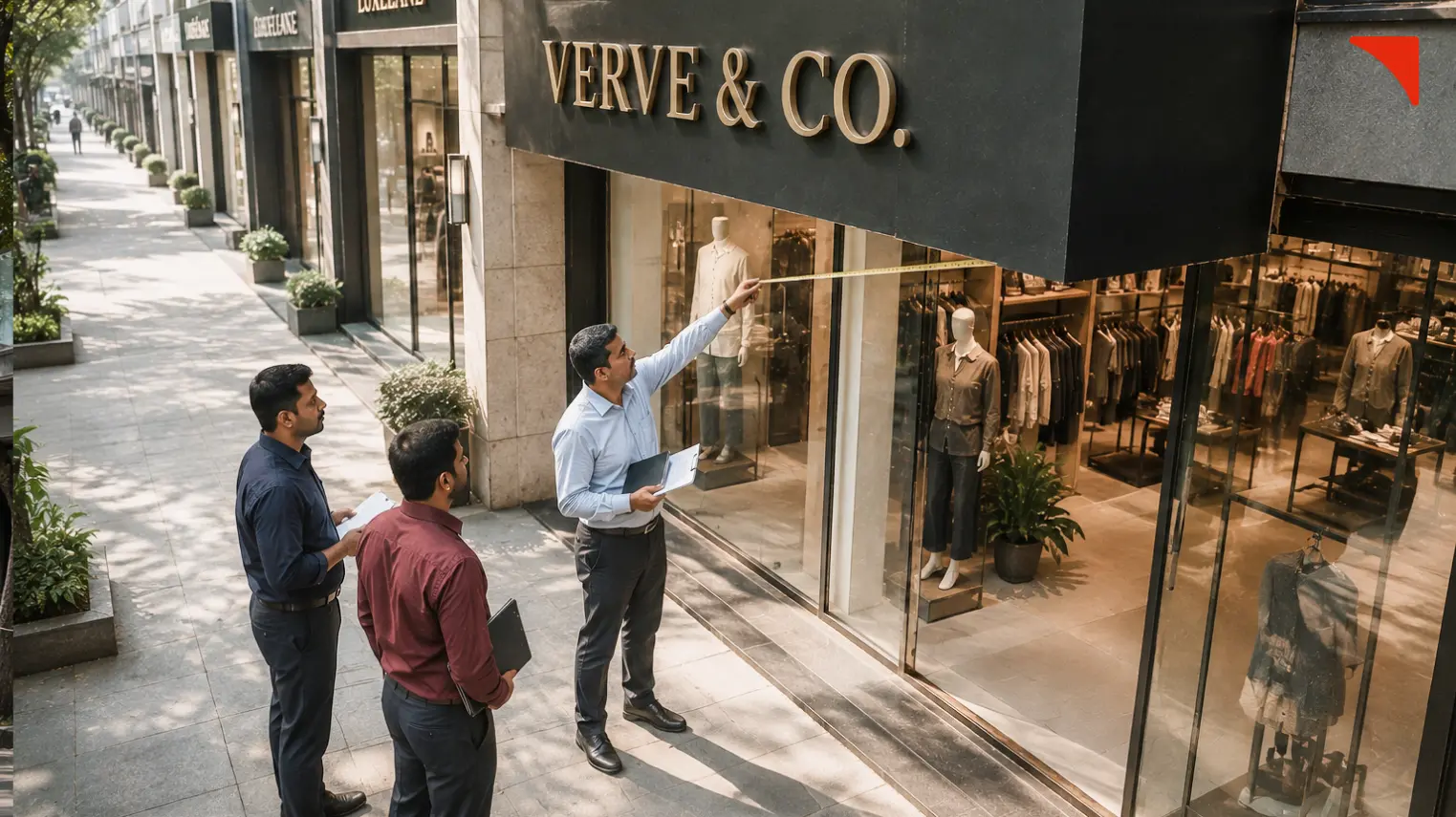
A retail outlet can be beautifully designed, perfectly merchandised, and ready for opening day. However, it can still be stopped by something as simple as a projecting sign or an unsafe storage rack. The biggest risk in this case is not the correction itself, but what actually happens to the business when correction arrives after money, time, and operational plans have already been committed.
In today’s scenario, the concept of retail compliance is increasingly moving beyond the traditional idea of licences, paperwork and final inspections. For brands expanding to new store formats and locations, it is getting converted into an operational risk that can severely affect store openings, customer access, revenue and profitability, brand reputation and customer perception, and rollout timelines.
When Compliance Starts Affecting Continuity
Recent enforcement actions show why this shift matters.
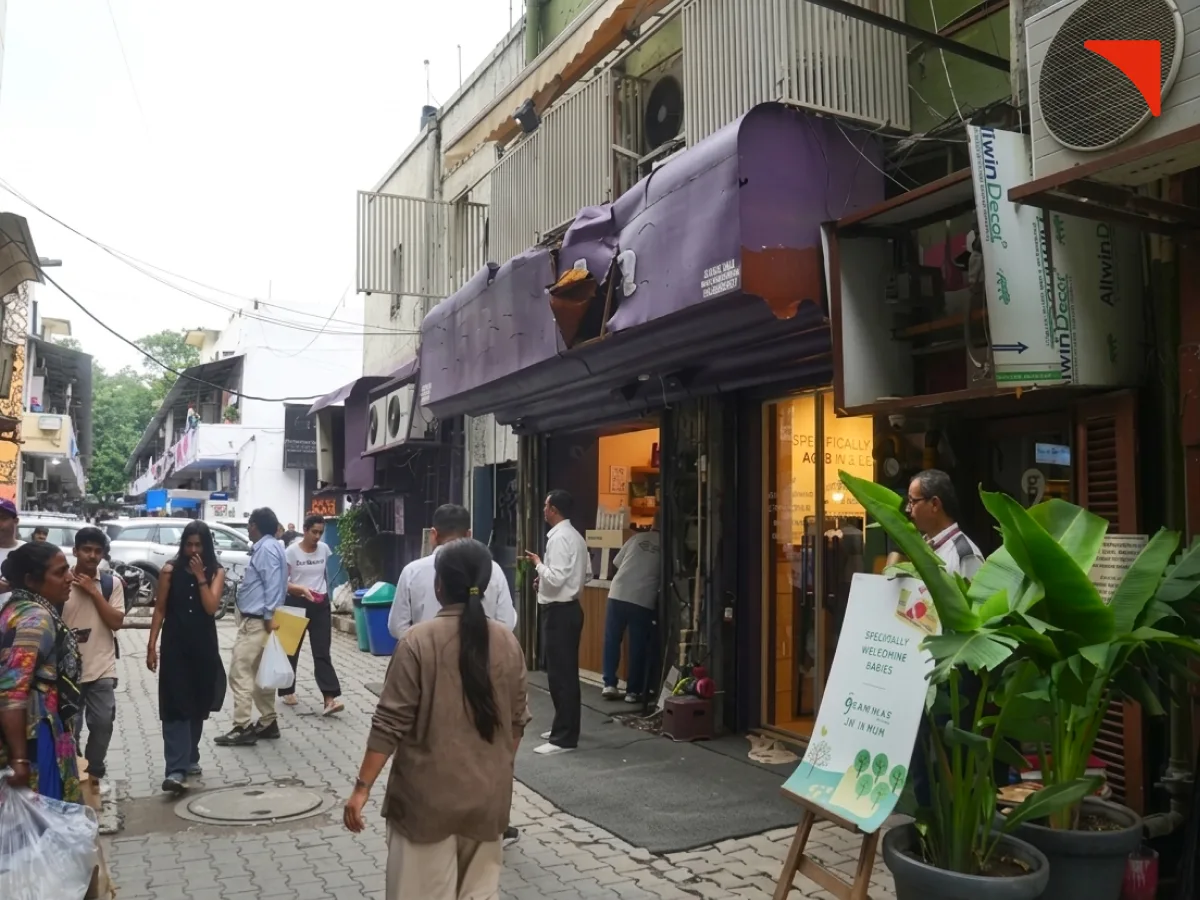
On 11 August, the New Delhi Municipal Council conducted an inspection in Delhi’s Khan Market. During the inspection, they highlighted various concerns related to signage violations and encroachment. Some signs reportedly extended four feet and projected over roads. This automatically led to the development of safety concerns. NDMC removed several oversized and non compliant signage and other projecting elements from shops and restaurants present in that respective market.
Traders and shopkeepers started a protest at that moment, due to which NDMC had to pause this drive.
The lesson for all the retail shop owners was bigger than signage. They experienced an unimaginable situation in which a facade element that was actually considered as a design detail suddenly became an operational issue.
A similar pattern was also noticed in Maharashtra’s food and quick commerce sector. The state FDA (Food and Drug Administration) inspected approximately 86 establishments, out of which 60 were given an improvement notice. They also suspended permits at 12 warehouses linked to Blinkit, Zepto, and Swiggy Instamart, mainly because of poor hygiene, pest issues, dirty or rusted racks, and unsafe storage conditions.
In both of these situations, compliance was not all about avoiding a penalty. But after looking at things the other way around, it was non compliance that actually had the potential to interfere with the ability of a business location to operate normally.
Well, this is exactly why it is important for retailers to rethink compliance.
The Problem With Checking Compliance at the End
When talking about a traditional retail rollout, compliance might actually be considered as a final stage activity. The store design gets approved, materials are finalized and ordered, fixtures are manufactured, and the operational team begins with the implementation work. After all this, someone might ask whether everything meets local requirements, or instead, they might skip this completely.
That sequence truly creates unavoidable risks. But how?
Understand this better with an example.
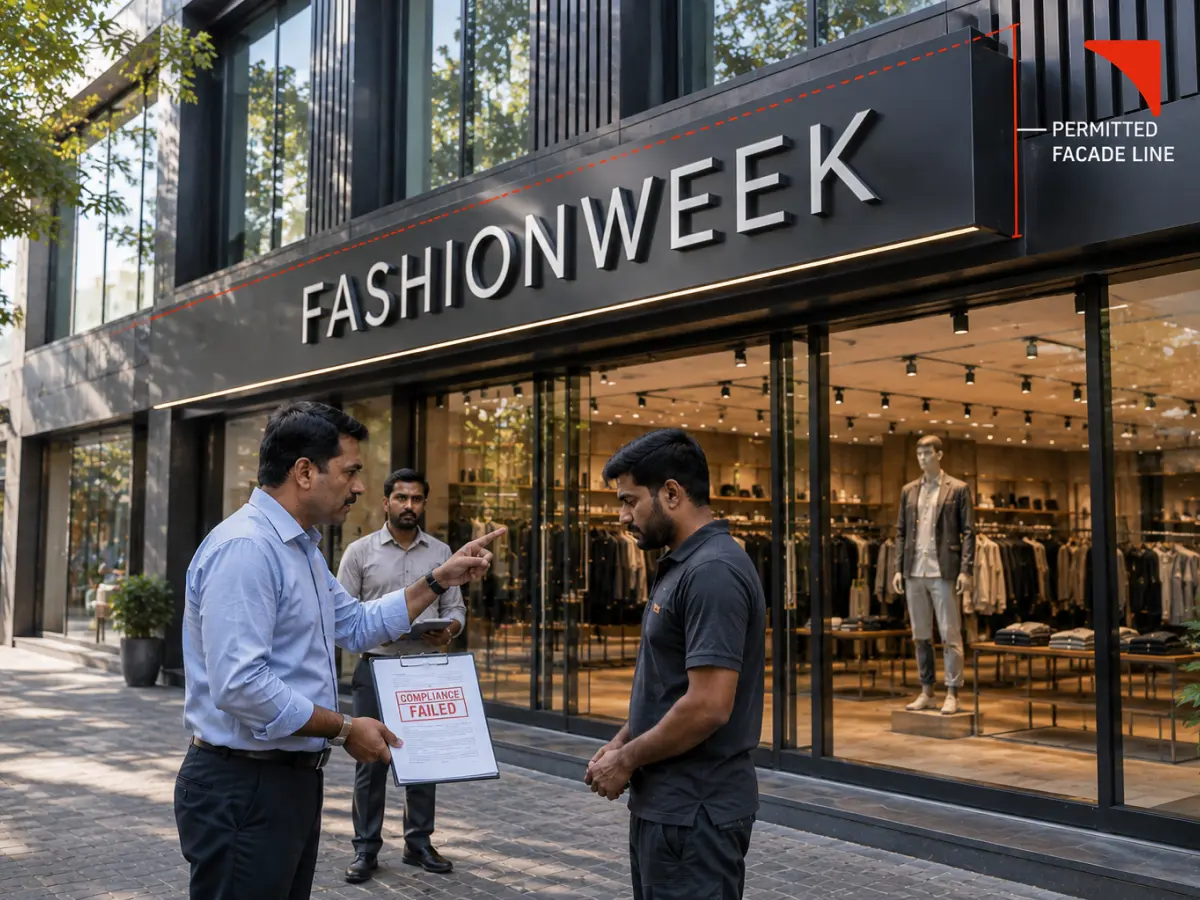
Consider a store facade. If the retail team finds that the signage projection is exceeding the permitted envelope after it has been designed and manufactured, they will have to get it redesigned and manufactured again. This rework automatically means fabrication changes, extra transportation costs, and delays in final signage installation that will eventually affect the store launch as well. The problem can become even more disruptive in case an issue with the electrical installation or emergency route is found during inspection.
According to the National Building Code Framework, retailers need to recognize that signs and outdoor display structures do involve public safety, structural safety, and fire safety. Hence, they should be compliant and adhere to all the permissions and requirements.
Well, this makes one point clear: Retailers cannot treat compliance as a single approval aspect that just needs to be considered at the end of a project.
What Should a Retail Compliance Check Actually Cover?

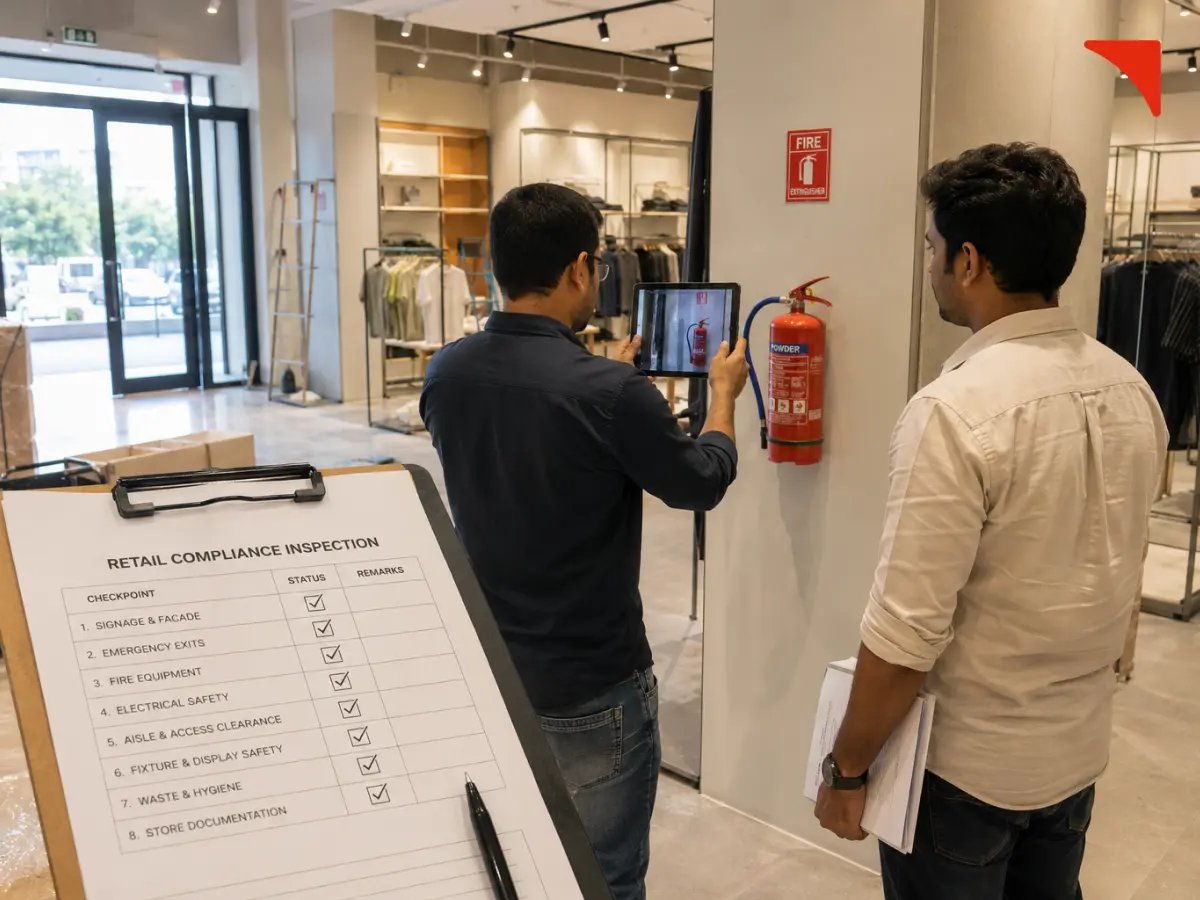
A useful compliance framework is not just about licenses and paperwork. Instead, it goes way beyond that. Mentioned below are a few key points that should necessarily be included in a retail compliance check.
When brands have a larger retail footprint and huge operational networks, they need to standardize all these checks, that too, without assuming that every location has identical conditions, because obviously, they don’t. In this scenario, creating a central design or brand guideline can help in establishing a baseline. On the other hand, site level surveys can further assist in identifying local deviations before the beginning of actual retail execution.
The Missing Layer Is Evidence
For brands that are proceeding with their retail expansion and are moving to new locations and store formats, just knowing that their stores were checked is not at all enough.
Instead, it is important for the leadership to be aware of what all was checked, where, when, against which requirement, and what evidence exists that they can rely on. This cannot be ignored when the matter is about hundreds or thousands of locations.
Clearly, it is close to impossible for a central team to physically remember everything, including facade dimensions, fixture conditions, site modifications, or approval status. This is exactly why digital records need to be considered as an important part of the compliance infrastructure.
Brands can seamlessly establish an auditable trail by using aspects like geo tagged photographs, site observations, approval documents, checklists, and closure evidence. In addition to this, conducting virtual and physical store audits can also help in identifying deviations and minor issues before they get converted into expensive operational problems.
On the other hand, establishing centralized project visibility can help in connecting this site level information with the wider rollout. This will help retail teams move beyond treating every store as an isolated project and instead allow them to track recurring issues, corrective actions, and readiness across locations.
So, what’s the real question for expanding retail brands?
It is not, ‘Do our stores meet compliance requirements at the time of inspection?’
But, ‘Has compliance been built into the entire retail project from the initial stages in order to prevent disruption in the first place?’
Because in a massive retail network, a compliance failure is not equivalent to just a compliance problem. Instead, it is actually equal to a delay, a cost, a closure, and ultimately a business continuity risk.