
It usually begins with the idea of saving cost.
You’re planning a 100-store expansion across India. It definitely feels smart and even obvious on paper.
Why move heavy fixtures from one central factory to smaller cities? That sounds expensive and slow. Why send your own crew across the country? Local vendors are already aware of the area, and hence, can get things done faster.
The localised approach seems efficient as it promises lower logistics costs, speedier response, and, most importantly, smaller upfront bills.
You finally decided to decentralise the work.
After dividing the map and onboarding 50 localised vendors, including carpenters, sign-makers, electricians, and fixture installers, you are convinced that this is not just a simple and smarter choice, but a scalable model.
But this is exactly where the “Expansion Trap” begins.
What appeared cost efficient on paper quickly transforms into an operational nightmare. The direct savings you expected start disappearing, and are replaced by an indirect wave of hidden costs. And if your retail operations are managed by multiple local vendors, you are not just multiplying your operational footprint, but are also expanding the chaos that comes with it.
The View from the Brand Side Marketing Retail Head: The Death of a Thousand Design Mutations
For any retail brand, success is not just about increasing the number of stores. Instead, it is about protecting the brand integrity across every touchpoint.
You spend months with designers perfecting the flagship store. Every single detail, from the exact shade of Pantone that reflects your identity, the precise lighting temperature that enhances product appeal, and the seamless standard of finish that creates a premium experience is intentional.
But once you share this blueprint with 50 localised vendors, things begin to change. Consistency fades, small differences creep in, and your brand starts losing its uniform look and feel.
Hidden Cost #1: The Mutation of Identity (Brand Entropy)
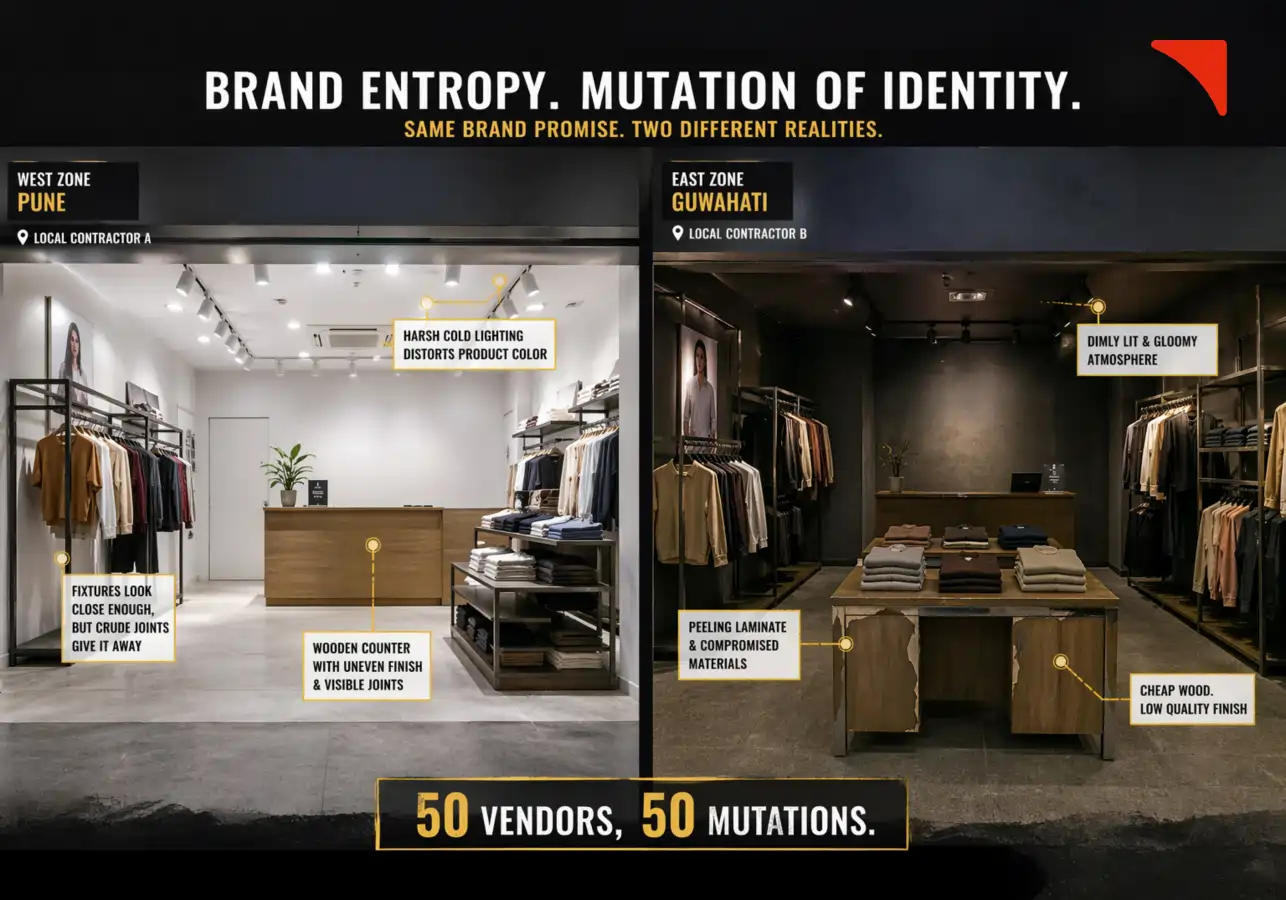
Every vendor works differently by using their own methods. This is exactly where the difference begins. A vendor in Pune might interpret your design guide differently, whereas a vendor in Guwahati might read it in another way. Suddenly, the lighting in your West Zone stores feels too cool and bluish, affecting how products look. On the other hand, the stores in the East Zone look dimly lit. All fixtures look similar from a distance. However, when looking at things from close, the gaps tend to show up: poor finishing, uneven joints, and compromised materials.
The Hidden Cost: You’re no longer building one consistent brand. Instead, you are actually running multiple versions of it. And your multi crore investment to create a premium identity is neutralised because poor execution by localised vendors doesn’t match the vision.
Hidden Cost #2: Delayed Speed-to-Market
When we talk about retail expansion, time is the absolute enemy. In order to open 50 stores in a seamless manner, everything needs to move in sync. But clearly, 50 local vendors create 50 points of coordination, and hence, now you have 50 chances for something to go wrong.
If a signage manufacturer in Kanpur runs out of raw material, it delays the entire launch. Similarly, the launch timeline slips if a team in Kochi misreads the electrical layout and makes a mistake.
One small issue—and the whole rollout slows down. Your brand starts losing launch days, marketing momentum, and even market share.
The Hidden Cost: Scaling fast relies on speed-to-market. But it's consistency that’s required to scale right. When you deal with scattered local vendors, you basically end up getting neither.
From the Procurement Side: When Complexity Takes Over
For a procurement head, hiring local vendors definitely seems to be a lower immediate unit cost, as the cost per vendor looks comparatively cheaper on paper.
But the reality is different.
The hidden operational overhead destroys any paper savings. If your team is dealing with 50 different vendors, they aren’t procuring any more. Instead, they are just managing a scattered and difficult supply chain every single day.
Hidden Cost #3: The Administrative Burden
Now think about what it actually takes to manage 50 vendors.
Managing 50 localised vendors is indeed an overwhelming task. Instead of focusing on strategic vendor consolidation and value engineering, your procurement team is stuck handling day-to-day coordination and constant follow-ups.
The Hidden Cost: The effort and time required to manage this system exceed the savings it was designed to bring.
Hidden Cost #4: Logistical Fragility vs. Centralized Efficiency
Using localised vendors may seem to reduce the logistics cost. However, the truth is that it creates logistical fragility. Everything becomes scattered because you will have to deal with different supply chains, different timelines, and different levels of reliability. Clearly, instead of reducing the cost, managing multiple shipments, vendors and timelines results in higher total logistical spend.
Now compare this with a situation in which you collaborated with a centralised partner like D’Art Private Limited. All fixtures and displays were designed and manufactured in a controlled factory environment. They were further shipped en masse as ready-to-assemble parts. This directly shifts on-site execution from messy construction to clean assembly.
Instead of sending crews everywhere, a centralised partner like D’Art utilises a standardised system to deploy retail units.
The Hidden Cost: Real savings in retail rollouts do not come from choosing the cheapest location. Instead, they come by building a system that works consistently.
Hidden Cost #5: The Data Black Hole (Managing Multi-Crore Budgets on WhatsApp)
When you depend on 50 different local vendors, you don’t really have a data ecosystem. Instead, all you have is a WhatsApp group.
You have no other option than managing multi crore rollout budgets based on blurry photos and random messages like “Trust me, sir, work is happening.”
Because local vendors operate offline, there is no proper connection with your enterprise systems (like Salesforce or SAP). Your upstream procurement data is completely disconnected from downstream execution reality. And delays, you usually find out at the last minute—when the ribbon-cutting is supposed to happen tomorrow.
The Hidden Cost: You are actually working without clear visibility. And because you are not managing risks but reacting to problems due to a lack of real-time data, forecasting accurately becomes nearly impossible.
The Solution: The Retail Execution OS (Intelligence, not just Installation)
You have two options: You can either choose localised chaos or, else, you can choose intelligent systematisation.
At D’Art, we realised that in order to scale a brand flawlessly, you need more than vendors; you need a strong technology backbone. As an integrated retail agency, we do not just build stores. Instead, we power them through our proprietary Retail Rollout Dashboard, a centralised operating system built for large-scale execution.
Enterprise Integration (The Single Source of Truth): Everything is linked to everything else. From initial BoQ (bill of quantities) and approvals to on-site execution, everything is integrated directly with enterprise CRMs like Salesforce in one transparent, unbroken digital ecosystem. No missing data, no lost invoices, no confusion.
Real-Time Status & Live Visibility: No more chasing vendors for updates. Our dashboards allow real time tracking. Your retail and procurement heads get granular visibility into every single site. They can simply log in and see exactly how work has been completed in Gurugram vs Bengaluru, backed by real data and not guesswork.
Predictive Intelligence: We don’t just focus on tracking the process but on staying ahead. Our intelligence platform monitors the entire supply chain and flags and adjusts the plan if something gets delayed. This directly helps prevent extra costs and also protects the final launch date.
In short, D’Art doesn’t just execute; we ensure controlled, predictable scaling.