Cargill
CLIENT
Cargill
INDUSTRY
FMCG
CLIENT
Cargill
INDUSTRY
FMCG
Cargill is indeed one of the world’s leading food and agricultural companies that has a strong presence in the Indian FMCG market as well. Through the introduction of Leonardo Olive Oil, the respective brand aimed at launching healthier cooking alternatives into the Indian households, that too, at a time when food awareness was steadily rising. Indian consumers were highly influenced by movements like “read the label,” organic sourcing, and healthier fat consumption. These aspects significantly impacted their purchasing patterns and positioned olive oil as an aspirational yet emerging choice for them.
Irrespective of the fact that the degree of awareness was increasing amongst Indian customers, olive oil was still considered as a niche category in a highly competitive and cluttered FMCG retail environment. Hence, in order to scale Leonardo Olive Oil beyond a limited audience, Cargill was looking forward to a powerful in-store strategy: one that could facilitate quick, last minute decisions and develop strong recall at the shelf. This is exactly what gave birth to Cargill’s and D’Art’s partnership.
When D’Art collaborated with Cargill, the first thing we did was market analysis. We found that, though the Indian consumers were increasingly becoming food conscious, cooking oil still remained a purchase that was deeply influenced by habit. The market analysis also helped highlight various critical barriers that Cargill’s Leonardo Olive Oil needed to overcome at the POS (point of sales).
The FMCG brand’s brief for D’Art was clear: design and execute an in-store solution that isn’t just functional, but instead, captures attention and influences choice at the exact moment of decision and acts as a visual spokesperson for the Leonardo brand.
To help Cargill overcome these challenges and meet the brand’s expectations, D’Art provided solutions that focused on transforming functional in-store displays into robust visual and storytelling tools that significantly influenced quick, shelf level decisions. Though Indians were generally resistant to experimenting with cooking oils, they still finalized their choices on the shelf. As a result, we designed the FSU (free standing unit) in a way that it acted as a spectacle that immediately captured attention.
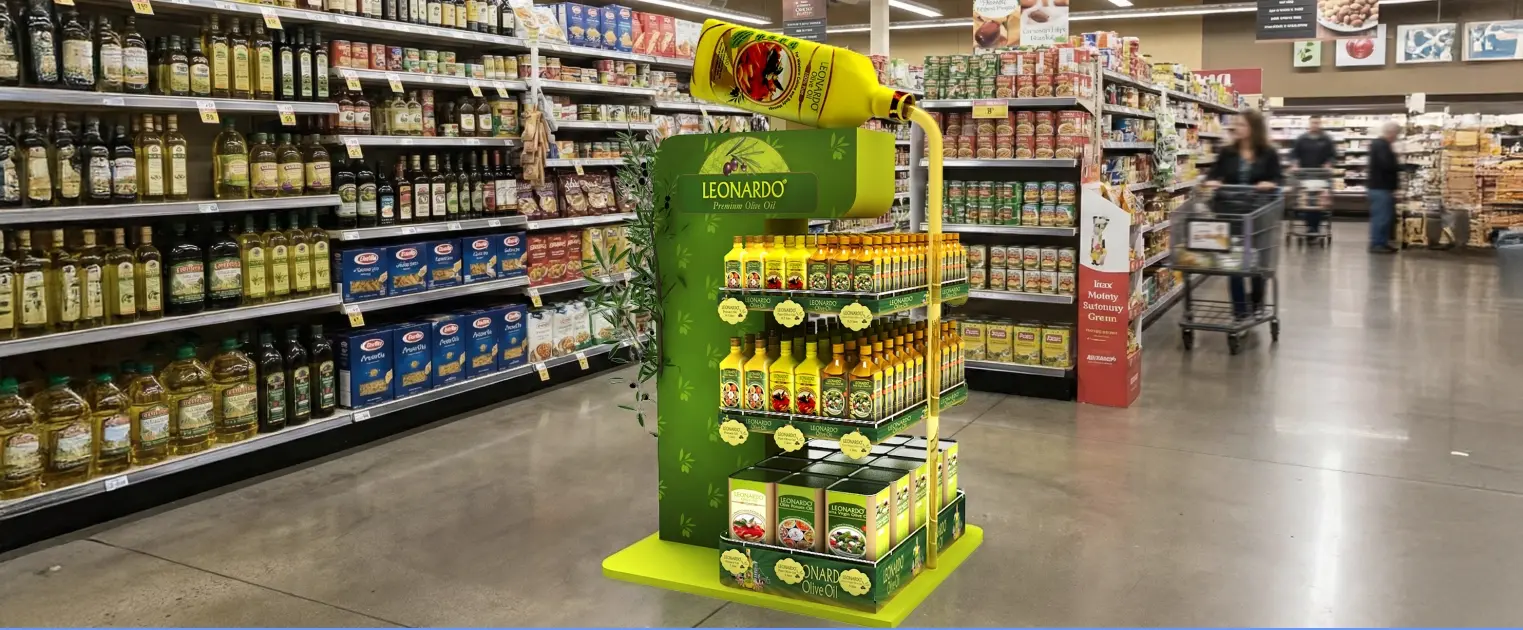
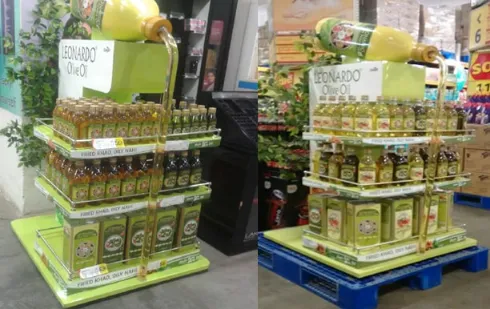
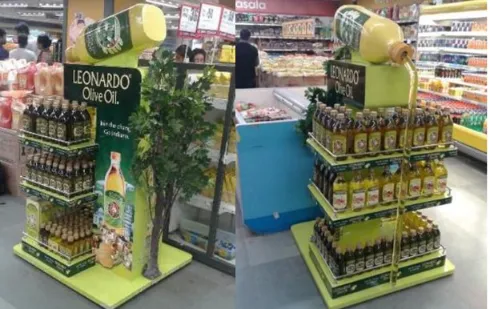
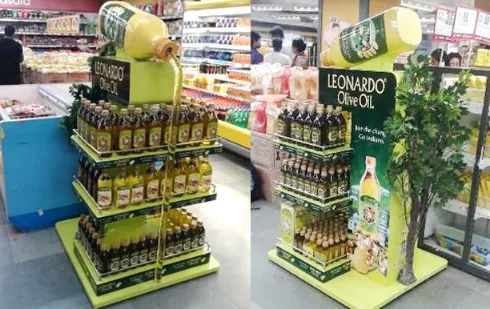
The D’Art team positioned an oversized Leonardo Olive Oil bottle as the central design element. It was dramatically titled and developed in a way to create the illusion of oil being poured onto the shelves below through a transparent acrylic stream. This bold, larger than life form disrupted the visual clutter of crowded, fast moving consumer good aisles and also sparked curiosity from a huge distance.
Apart from its dramatic appeal, the design also clearly communicated Cargill’s product category and reinforced brand recall, that too, without relying on excessive text, promotional messaging, or human intervention.
The floor standing unit functioned both as a display and a brand spokesperson. It guided consumers towards Leonardo Olive Oil through visual storytelling. The team at D’Art utilized scalable, durable materials to ensure that the respective units could be consistently reproduced across different locations, further enabling rapid rollouts while effectively maintaining strong visual impact and operational efficiency.
The floor standing unit that focused on visually appealing consumers was strategically placed in a manner that delivered a clear and measurable impact for Leonardo Olive Oil across markets.
By leveraging scale, curiosity, and strong visual language, the design converted shelf space into a powerful brand touchpoint—helping Leonardo Olive Oil move closer to mass acceptance.